
Sunlight pours through Nassau County windows every single day — and it’s quietly changing the color of your hardwood floors.
Most homeowners don’t notice until they move a rug or a couch and find a mismatched patch underneath.
Can sun-damaged floors actually be saved, or is replacement the only option?
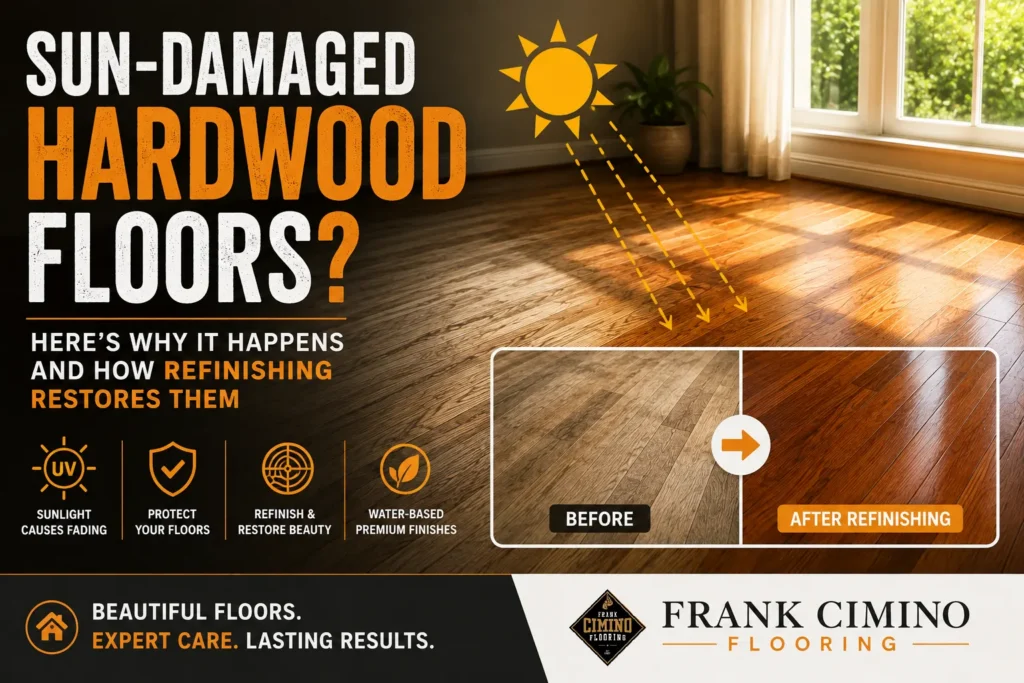
Here’s what’s really happening to your wood, and how professional refinishing brings the original color back.
Yes — sun-damaged hardwood floors can almost always be restored. UV rays, visible light, and infrared heat break down wood pigments and cause oxidation, but this discoloration usually sits only in the top layer of wood fibers. Professional hardwood floor refinishing sands away the damaged surface and reseals your floors with a UV-resistant, water-based finish — restoring a consistent, like-new color throughout the room.
| Symptom | What It Means |
|---|---|
| Faded, lighter patches | UV bleaching of wood pigments |
| Dark, blotchy patches | Oxidation of exposed wood |
| Rug or furniture outlines | Uneven UV exposure across the floor |
| Yellowing finish | Aging or amber-toning polyurethane |
| Dull, hazy finish | Finish breakdown from UV and heat |
| Hairline surface cracks | Heat exposure and excessive dryness |
Not all wood reacts to sunlight the same way.
Exotic species often change color much faster — and more dramatically — than domestic ones.
| Wood Species | Typical Color Change |
|---|---|
| Red Oak | Slightly lighter |
| White Oak | Mild change |
| Maple | Lightens |
| Hickory | Slight fade |
| Walnut | Lightens slightly |
| Cherry | Darkens significantly |
| Brazilian Cherry | Darkens rapidly |
| Tigerwood | Major color shift |
| Mahogany | Richer, darker tone develops |
Exotic species contain higher levels of natural extractives, which react more aggressively to UV exposure than the pigments in domestic species like Oak or Maple.
Your floor’s finish is its first line of defense against the sun.
Not every finish offers the same level of UV protection.
| Finish | UV Resistance | Yellowing Risk |
|---|---|---|
| Oil-Based Polyurethane | Low | High |
| Water-Based Polyurethane | High | Very Low |
| Hardwax Oil | Moderate | Low |
| Aluminum Oxide (factory) | Excellent | Low |
Most flooring professionals, including our team, recommend modern water-based finish systems for their superior clarity and UV resistance.
Prevention is far cheaper than a full refinish.
A few simple habits can add years to your floor’s original color. A properly protected floor includes:
Low-E glass reduces both UV and infrared transmission while also improving your home’s energy efficiency — making it one of the best long-term investments for sun-exposed rooms. According to the U.S. Department of Energy’s Consumer Guide to Energy-Efficient Windows, Low-E coatings can reduce UV-induced fading of household furnishings and flooring by as much as 75%.
Fading isn’t caused by one single thing.
It’s the combined effect of three types of energy hitting your floor every day.
UV light breaks down natural wood pigments, triggers oxidation, and permanently changes the wood’s surface color. The National Wood Flooring Association notes that this kind of color change is a normal characteristic of wood exposed to light and air over time.
Visible light itself carries energy that degrades wood pigments over time — even through windows with UV-filtering glass.
Infrared heat accelerates aging, dries out finishes, and causes the expansion and contraction that can lead to gaps or cracks.
We see this most often in homes throughout Lynbrook, Oceanside, Rockville Centre, and surrounding Nassau County communities, especially homes with large south-facing windows and sliding glass doors.
Sun damage isn’t evenly spread across a home.
It concentrates in a handful of high-exposure zones:
In most cases, yes. The right fix depends on how deep the damage goes:
If you’re unsure which category your floor falls into, a professional hardwood floor refinishing inspection can confirm it before any sanding begins.
Sometimes — it depends entirely on the thickness of the top wear layer, the real hardwood sitting above the plywood core.
Floors with a wear layer under 2mm usually can’t be safely sanded. A 2–3mm wear layer may allow light refinishing, and 3mm or more is often suitable for a full refinish.
If you’re not sure how thick your wear layer is, a professional inspection can confirm it before any sanding begins — sanding too aggressively on a thin wear layer risks exposing the plywood core underneath.
| Timeframe | What You’ll Notice |
|---|---|
| 3 Months | First subtle color shifts, often unnoticeable |
| 1 Year | Fading visible under furniture and rugs |
| 3 Years | Noticeable contrast between exposed and covered areas |
| 5+ Years | Significant, often permanent-looking discoloration without intervention |
Both options can restore your floor’s appearance, but the value comparison isn’t close. Refinishing typically delivers:
Exact pricing varies by region, square footage, and damage severity — but refinishing is almost always the better value when the wear layer allows for it.
Run through this checklist first.
If you’re unsure about several of these, a professional inspection is the fastest way to get clear answers.
Many Nassau County homes have oak floors that are 50–100 years old, with large windows and sliding glass doors that accelerate sun damage. Professional refinishing helps restore consistent color while avoiding common problems that occur in older Nassau County houses.
Yes, if left untreated long enough. Most UV damage sits in the surface layer of the wood and can be removed through professional sanding and refinishing.
The rug blocked UV and light exposure while the surrounding floor kept fading, creating a visible contrast once the rug is moved.
Exotic species with high natural extractive content, like Brazilian Cherry and Tigerwood, tend to show the most dramatic and rapid color change.
They significantly slow it by offering better UV resistance and reduced yellowing, but no finish makes hardwood completely fade-proof.
Only if the wear layer is thick enough, generally 2mm or more. A professional can confirm this before starting.
A typical refinishing job takes about 3 to 4 days, factoring in inspection, sanding, staining, finishing, and dry time.
Yes. Quality UV films block a large percentage of harmful UV rays while still allowing natural light into the room.
Every six months is a good baseline for most sun-exposed rooms.
If your hardwood floors have faded, yellowed, or developed noticeable rug marks, professional refinishing can often restore a consistent, like-new appearance — without the cost of full replacement.
Our team sands away surface-level UV discoloration, applies premium water-based finishes for lasting clarity and durability, and helps protect your floors against future sun and wear damage.
Get a free estimate today and find out whether refinishing is the right solution for your home.